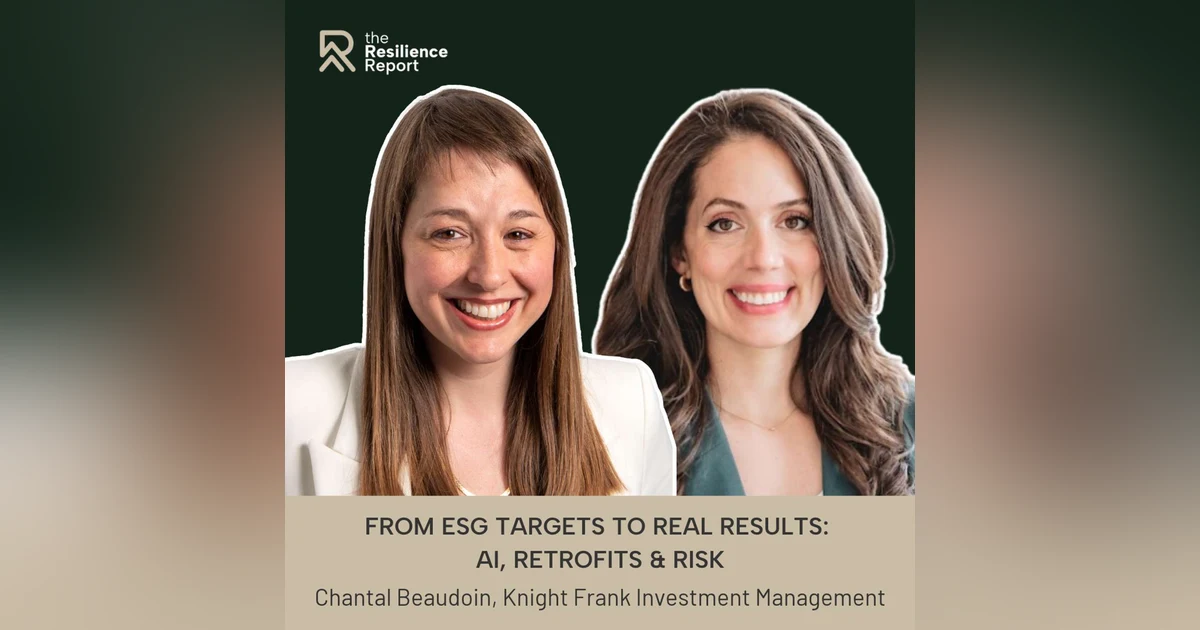
From ESG Targets to Real Results: AI, Retrofits & Risk ft. Chantal Beaudoin (Knight Frank Investment Management)


 Spotify

 Apple Podcasts

 Amazon Music

 RSS Feed
Net-zero deadlines are slipping, business cases aren’t stacking up, and many companies are finding out that setting a target was the easy part. So what does it actually take to move sustainability from a promise to a payback?
Nearly four years after she was the very first guest on The Resilience Report, Chantal Beaudoin returns. She’s Partner and Head of ESG at Knight Frank Investment Management, where she oversees ESG strategy across roughly £4 billion of real estate. Chantal has spent more than 20 years delivering sustainability across real estate, hospitality and higher education, including roles at McDonald’s UK, Lamington Group and the London School of Economics.
In this episode, host Lauren Scott and Chantal discuss:
- How tenant energy data went from a “black hole” to near-full visibility, and how AI-driven building optimization delivered savings of up to 17.5%
- Why the gas-versus-electricity price gap is the biggest barrier to net zero she sees, and the regulation that could change it
- What happened when her team ran more than 50 solar assessments and only around five went ahead
- Why two consultants can give the same building completely different paybacks
- Where embodied carbon really stands in the industry today
- Career advice for sustainability professionals in 2026: focus on value and risk
- Why resilience comes down to having the courage to do things differently
Whether you lead a business, manage property or are building a career in sustainability, this conversation is a candid look at what works, what fails and what to do next.
🔗 Connect with Chantal Beaudoin: https://www.linkedin.com/in/greenwonderwoman4real/
🔗 Knight Frank Investment Management: https://www.kf-im.com
🎧 Listen to Chantal’s first episode: https://www.theresiliencereport.ca/2-difficult-discussions-that-move-the-esg-needle/
🔗 Connect with Lauren Scott: https://www.linkedin.com/in/laurenscott514/
Enjoyed this episode? Follow The Resilience Report, leave a rating, and share it with a leader who needs to hear it.
#TheResilienceReport #ESG #NetZero #Sustainability #CommercialRealEstate #Decarbonisation #RetrofitFirst #ClimateRisk #SustainableBusiness #Leadership
What does it actually take to move sustainability from a promise to a payback?
Almost 4 years ago, the very first guest to record on The Resilience Report was Chantal Beaudoin. Today she’s back, and a lot has changed. Net-zero deadlines are slipping. Business cases aren’t stacking up. And plenty of companies are finding out that setting a target is the easy part.
Chantal has spent more than 20 years on the hard part. Today she’s Partner and Head of ESG at Knight Frank Investment Management. She oversees ESG strategy across roughly £4 billion of real estate. Before that, she helped launch what was billed as the world’s first Whole Life Net Zero Carbon hotel with Lamington Group. She also led the switch from plastic to paper straws across McDonald’s in the UK, and she held sustainability roles at the London School of Economics.
In this episode, Chantal shares how using AI to optimize one office building delivered savings of up to 17.5%. She explains why, out of more than 50 solar assessments, only around five have gone ahead, and what the rest taught her. And she breaks down the price gap she sees as the biggest barrier to net zero.
If you’re a leader trying to turn sustainability into value, not just reporting, this one’s for you.
*
[Host: Lauren Scott] Welcome back to another episode of The Resilience Report. For our long-time listeners, you'll know that we actually started this three and a half years ago, which is kind of crazy how fast it's gone, but our very, very first guest is actually back today. And for anybody who works in the sustainability space, you know that so much has changed for those working in the space over the past three and a half years. So, Chantal Beaudoin is actually back with us today, and we're going to be seeing what has evolved since then, and she's going to be sharing her expertise with us. So, welcome back to the show, Chantal.
[Guest: Chantal Beaudoin] Thank you for having me, Lauren.
We definitely encourage everybody to go back and listen to that first episode, although, admittedly, my audio was not as good back then, but we definitely encourage people to check it out. But for those who haven't had the opportunity, would you mind maybe just quickly introducing yourself, Chantal, and then a little bit about what you do professionally at Knight Frank?
I am partner and head of ESG at Knight Frank Investment Management, referred to as KFIM. KFIM is a daughter company of the global real estate firm Knight Frank. As a real estate investment manager, we manage property investment on behalf of our clients. That means making investment decisions and actively managing the buildings throughout their life cycle, from capital investment, to asset management and strategy, all the way to disposal. And our goal is to protect the asset, in terms of working with the tenants, and protecting the long-term value of those assets. So my role within that is to embed sustainability in those decisions, whether that's net zero, energy efficiency, climate resilience, biodiversity, social impact, and governance, and reporting back to our clients and stakeholders.
As we said at the top, a lot has changed, I'd say, probably in terms of the macroeconomic environment since we chatted in 2023. But how has your role evolved? And again, for our listeners, maybe they do work in the sustainability space and will probably see themselves very much in your own experience, and then others who are more curious about the area.
I think the biggest shift has been from understanding our baseline and working to create our strategies, to moving to that delivery piece. It's been a bumpy road, and so that delivery is still in the growing stage. But what that means is really getting into the practicality of embedding ESG within asset management. And so, I would say, since then, ESG has become much more integrated across all the different elements of asset management. We've revised all of our investment committee forms, we've revised the way that we manage our assets day-to-day, and as well in terms of our reporting.
And I think what's really unique is how you've managed, and you've mentioned it there, to weave it in across the business. You sometimes see companies who have one lone sustainability person who is kind of doing nice-to-have projects, if you will, probably less and less so, but you've managed to really weave it into the organization, and certainly at the operational level. So, what do you think has been part of that success? How have you managed to do that within the organization?
The way that I've managed to embed ESG is through understanding the points at which decisions are being taken. So, for example, I've really learned that lease renewals, new leases, lease re-gears, or capital expenditure are key points where it's an appropriate time to engage with the tenant, or look at ESG initiatives, and it's the time to really focus on that opportunity for growth. And so, what I've learned is to really understand those key points, and then work with the asset managers to make sure that they have the right information and are ready to deploy and to recommend at those strategic moments.
You were certainly ahead of the curve when we first chatted. In 2026, everyone's talking about AI, to the point that it's kind of silly when you walk around trade shows. Everyone says they do AI all the time. But in 2023, you had actually brought it up in the context of energy use within the built space. You referred to it perfectly: energy use is actually often almost like a black hole for landlords, because it really sits at that tenant level. And you were hopeful, at least three and a half years ago, that maybe AI could be used to help either extract or make sense of some of the information. Has that come to fruition? Have you seen maybe little glimmers of hope? And maybe it's been through using other tools. I'm very curious to see how that's turned out over the past few years.
Yes, we've really managed to, not increase, I would say decrease this black hole, because we've gone from not really knowing what our footprint was, what our tenant footprint was, to one of our funds almost reaching 100%. I would say overall, across all of our assets under management, we're still at around 60 to 70%, but with these key funds where we have a targeted ESG strategy, we've really maxed out that data. What that means is we've engaged with the tenants to request consent, and we're now automatically feeding the data from the National Grid using different online platforms, which then generate the consumption and carbon impact.
What that has meant as well, especially for properties that have half-hourly data points, is that we're now able to see when systems come on, when systems come off, and understand why there are these peaks, and really get to work with property managers and facilities managers to then question the settings in the buildings. Is there something that we're not completely aware of that should be tweaked and modified?
I think I had also talked about BMS optimization, so using AI to optimize a building. How that works is, it's a platform that connects to your building management system and creates a digital twin to then understand inefficiencies in how the settings have been programmed. Through that initiative, for the past 21 months now, we've implemented BMS optimization in one of our office buildings, and we've seen savings reaching 17.5%, consistently saving not just kilowatt hours, but costs. So really finding solutions that are not only impacting the environment, but also creating value and cost reductions.
And you mentioned at the top as well that you're based out of London, in the UK, and the Mayor of London has come out and said that, unfortunately, the city won't be meeting its 2030 net-zero targets. I'm sure that's multifactorial. But if we keep our buildings hat on, where would you say some of the biggest challenges remain that are maybe factoring into the city not being able to reach those targets, and maybe areas that we can focus on?
I think the biggest element is the price differentiation between gas and electricity. The market rate for gas is around, I want to say, 6 or 7p per kilowatt hour, and then you have, in the UK, a price of around 26p for electricity. So, when you look at initiatives to reach net zero that require removing gas and electrifying, the business case is really hard to achieve. Even if heat pumps produce up to 30% or more efficiencies in terms of consumption, the business case doesn't stack up with the price differentiation of gas and electricity. So I think that's the biggest challenge that we're seeing in our implementation: that business case.
I would love to double-click into what it will take, maybe, to bridge that gap, because money definitely talks. Is it a subsidy? Is it government incentive programs? Is it penalties? Is it more from the grassroots side of the market? Where do you think we'll be able to bridge that gap, knowing that right now, it's just not financially viable to do the transition?
I think there's a role for legislation. We've seen that in the UK with the MEES regulation, where currently any building with an EPC, which is an Energy Performance Certificate, rated F or G cannot be rented out. So there's a big incentive to increase the efficiency of buildings. Now, the next timeline is to reach a B by 2031. It's a white paper, and the government is still talking about it. They've moved it from 2030 to 2031, so we do think it's coming into play, but it hasn't been confirmed. I think as soon as that is activated, you create that business case, because to reach an EPC B, you do need to de-gas and remove fossil fuels.
The second thing I would say is not seeing net zero as one element in terms of removing fossil fuels, but really seeing it as a collective of actions, starting with the fabric of your building, all the way to the different elements producing the energy. I think the business case then does stack up. And also, for us, it has been about understanding the life cycle of the plant. So, not just removing a gas boiler when you want to, but actually knowing when that end of life is, and then planning accordingly for other elements to come into the capital expenditure, and then having a retrofit plan that stacks up for both the tenant and the investor.
One of the challenges certainly seems to be, as well, that if it's a brand new building, we now know pretty well how to make it energy efficient, and we can even, as you were mentioning, have more responsible materials used to build the project itself. However, there are also considerations of either knocking down an old building to then build a new one, and so a lot of people are trying to think of it from a retrofit perspective, which is not always the easiest. In our last conversation, you had talked about embodied carbon being the next frontier for the industry. Three years in, do we feel like that's starting to take up enough of the conversation that we really will pivot people towards retrofitting rather than just scrapping a building and building something new with newer technology? Where do you think we're sitting in terms of that balance between embodied carbon and operational carbon?
I think in a retrofit project, obviously embodied carbon doesn't necessarily come into play as much as in a new build. We come into projects quite far down in the investment cycle, so I would say I haven't seen a lot of emphasis on embodied carbon. We have now started, for the funds that have these mandates, to have a whole-life net-zero carbon assessment done. And that has started to move the conversations around what type of cement, and what kinds of materials can be substituted. So, the conversations are definitely there. But on the ground, I'm not necessarily seeing that being adopted across the board yet. And certainly, what I'm seeing is that the targets around embodied net zero are far off from being achieved.
So still important to have on our radar, but maybe not necessarily yet in the day-to-day conversations. Well, I now live in Ireland, but previously both of us were actually based back in Montreal, and I at least personally would often look to the UK and Europe as well in terms of pushing and moving the needle when it comes to sustainability. Certainly right now, Europe is leading the charge on that versus North America. Having really lived through this journey in the UK, working in different sustainability roles, and having seen what works and maybe doesn't work, if other countries like Canada are looking to the UK to see what they could do and learn from the experience of a place that has been a little bit ahead of the curve, what would you recommend that we keep in mind as we're trying to build out and emulate elsewhere?
I think the biggest driver has been legislation. I've mentioned MEES, and we have the Climate Change Act for 2050. I think these are moving the dial in terms of actions and reporting, but also impact. So, I would say that's the first element.
The second is to really understand each asset and each building. There's no cookie-cutter solution. There are many tech solutions out there for energy reduction, and I think it starts with understanding your building and what kind of solutions could potentially be adapted to it, and then almost creating your roadmap for that asset, understanding not only the shell and the equipment in it, but also, and I think this is the next challenge, what is happening within that building. Is it a high-energy-intensity asset? That could be a supermarket with loads of fridges and freezers, it could be a bakery with ovens that need a lot of gas, or it could be a manufacturing process that, again, requires a lot of energy.
As investment managers, we don't control how the asset is being used, and our role is to engage with that tenant. What we've found is that those businesses that have set science-based climate targets are looking at their operations, so they will be looking at what kind of specification of ovens or chillers or equipment is specific to their business, and having a roadmap. So for us, our responsibility is within that shell and core, and then the tenant engagement to understand what their pathway is to reduce energy within their operation.
You're bringing up such an important point, and I don't think most people realize this unless you're working in the built space, of how unique each building is. From outside-inside operations, it's so distinct, and it can make it really complicated. A lot of our listeners, I'd say, are small to medium-sized businesses, and they're leaders in those organizations. If they're on the tenant side and don't have the luxury of working with someone like Knight Frank, where would you even recommend that they start? Is it reading legislation that can feel pretty heavy? I don't know what would be the best way, and this is just kind of coming to me as we're saying that, because I don't think most people realize how different each building is, and then each type of building as well.
I think for any business, it's to understand where their impact derives from, and understanding the specifications that they can put in place. We've worked with businesses that are looking to electrify, for example, their ovens. And they have now specified the dual availability of an oven that could be gas or electric. Because you might have a desire to electrify, but the technology or the grid capacity is not yet there. So it's about having the specifications that enable that transition to happen down the line. So I would say, understand your business operation and impact, and then, especially for businesses that are procuring equipment, look at the type of specification that could make a difference in 5 or 10 years' time.
And I would love to shift gears a little bit, because, again, I went into this on the first episode, but Chantal, for me, has been a role model in the sustainability space, and kind of pioneered that from way back. I would love to know how you have seen the sustainability job market shift. I do think 2026 is, again, a very interesting time to be in the space. If we have listeners who are either currently in it and feeling some challenges, or, again, we also have a lot of recent graduates who listen, what would you recommend that they keep in mind based on everything you've seen over the past couple of decades?
100%, there's a shift in terms of roles and positions in sustainability. In terms of what I would recommend, and what I'm actively promoting, it's value and risk mitigation. All of our initiatives, and back in the time when we were at the John Molson School of Business talking about the Sustainable Business Conference, it was about quantifying what's not being looked at. It's easy to just pay a waste bill, or pay an energy bill, and not really look at it in terms of risk as well: climate risk, flood, and climate hazards on a building or on a business. And so, the conversations now are all about value and risk, and I think that's where the conversation needs to be. So I would say, focus on those two elements.
I think that's super important, and just figure out how you can quantify the value of these considerations. I love that you mentioned a little bit earlier how you're not just saving energy, but you're saving money as well, on so many of these different opportunities. So just helping the broader business understand the value, and then certainly risk mitigation is a huge one, and I can only imagine for the built space in particular. Sustainability, and probably even commercial real estate, has faced some headwinds over the past couple of years or so, I would say. And yet, every time I talk to you, you're just as enthusiastic about what you do. So, how do you manage to keep that energy up, even when, from the outside, it seems like it's a little bit more of a challenging time?
I think what keeps me motivated is seeing the change happen. Right now, I'm setting the strategy, but the delivery and the know-how is with the asset managers, or the facilities managers. And now it's almost like I don't have to be on top of everyone. It's embedded. It's happening. And so, that's exciting, where you feel like the points where change can happen are being activated. Those conversations at lease renewals or new leases are being had.
And I've always been somebody that takes the open doors. There are going to be a lot of doors that close and that aren't possible. If I look at it, we've done over 50 solar assessments on our buildings, and that meant getting half-hourly data, understanding if solar was possible, and then creating the business case. Out of the 50, we've probably implemented, or are in the process of implementing, 5, which is quite sad. But each of them has failed for different reasons. And so, it's about understanding those failures, and then refining what we're looking for in a building that, for example, is suitable for solar. And you can apply that to heat pumps; different technology will work for different types of assets. So it's really, again, taking those challenges, taking the ones that have worked, and building on that. And that's where I get my motivation: seeing when it does work, and seeing how we can scale it.
It's so important to look at the wins as well, and it actually dovetails nicely. I wanted to follow up on something you had said last time, which was that we also need to embrace the failures. And so, it sounds like you're continuing to do so, and that's actually a perfect example with the solar. Do you have other examples of some failures, quote-unquote, that you've experienced over the past few years that you've learned from and that you're open to sharing with our listeners?
The failures that I can think of are around the business case of net zero. Sometimes you can do an audit with one consultancy that demonstrates a payback of 10 years, and you'll do that same assessment with another consultancy, with other sets of assumptions, that will show a totally different viewpoint. And that's been difficult. So what I've learned from that is to find partners that will do the assessment, but also look at the implementation, and set KPIs that link to the delivery of those reductions and net zero. So that's what we're working on now.
The other failure that we've seen is that you can make a building EPC A and have all the bells and whistles, but if what's inside the building is high energy, you're just not going to get there. For us, it's been about communicating that to our clients and stakeholders, so that we're transparent in that journey. And again, building on the successes. Where does it work? And where can we make an impact? And changing the targets and assumptions when we need to, and understanding the businesses behind the walls, and from that, creating a more bespoke strategy and roadmap to net zero.
Again, you're sparking different thoughts here. I would love for you to elaborate on that point, because I think a lot of businesses made some commitments based on certain assumptions, and now they're seeing those assumptions either fully play out, or not. For example, if I take an assumption that the grid will be greener by X year, and maybe it's not happening as fast, how do you think companies can level-set expectations while still trying to maintain the true intent of their impact? Because it does seem like, as we get closer and closer to some of these commitment timelines, companies are waking up to the fact that maybe some adjustments need to be made.
I think it's about being transparent, and laying it out in terms of: where are we at, what have we found, and what are we going to do about it? A lot of businesses have set targets without investment and plans to achieve them. Before we set our targets, we had our baseline and an understanding, in more generic terms, because you're never going to get to that exact roadmap for each asset. But we were able to map out, with lease renewals and the information that we had, a plan and a budget that would enable us to reach it. Now, along the way, we found information about budgets and information about assets, and so we're constantly communicating, but also revisiting those targets, and making them align with what is creating the best value for our tenants and our investors, and also driving the impact that we said we would.
Very fair. I think communication is always key. I do wonder, because certainly this is a journey for companies, but also for those of us who are professionals within the space: if you were to look at your career, perhaps, as a novel so far, and it's still being written, and we're looking at this specific chapter of your career, what do you think you would title that chapter?
I would like to title it “Moving the Needle.” Actually changing what's possible, and actually making an impact. Moving the needle is what's important for me right now, not just reporting. It's all about taking action.
That's so fair. I think so many sustainability folks get so tied up in the reporting that they don't necessarily get to go make the improvements. Not necessarily saying that's your situation, but I've spoken to so many sustainability professionals who feel like they just want to see the results of all of that work. And then, in terms of our listeners, I think it's incredible that you've already been passionate about this for 20 years, so for two full decades. You have so much of your story still to be written ahead of you, but if our listeners can learn from your experience, what's one thing you hope that they can take away from everything that you've gone through over the past two decades?
I think it's to take the open doors. There are going to be a lot of no's, and a lot of “it's not possible.” And there are going to be a lot of “Okay, I'm interested in that, let's explore further.” I would say, flow with the energy. Flow where the yeses are, and that will be both fulfilling and make an impact.
Well, by now, I'm sure our listeners understand why I look to you as a role model. But I do want to end with the same question that we always ask our guests, and that we asked you on that very first episode, which was recorded on January 1st, 2023. I remember it was New Year's Day. But I'm curious as to your thoughts, maybe it's changed or maybe it hasn't, on what you think it will take for businesses and leaders to be resilient going forward.
Having the courage to do things differently. We're in an era of legal fears, climate fears; there are just so many elements to be fearful of. And I think it's about letting go of that, and focusing on where there is an opportunity, and where there's a way to do things differently. And to have the courage to take those decisions, and to partner with other courageous leaders and partners to make an impact and to do things differently.
Excellent. Thank you so much, Chantal, for not only being our first ever guest, but then coming back on to share all of your experience since then.
Thank you!