Outrageous Optimism: Building Resilience from the Inside Out ft. Sara Bell (RIISE)
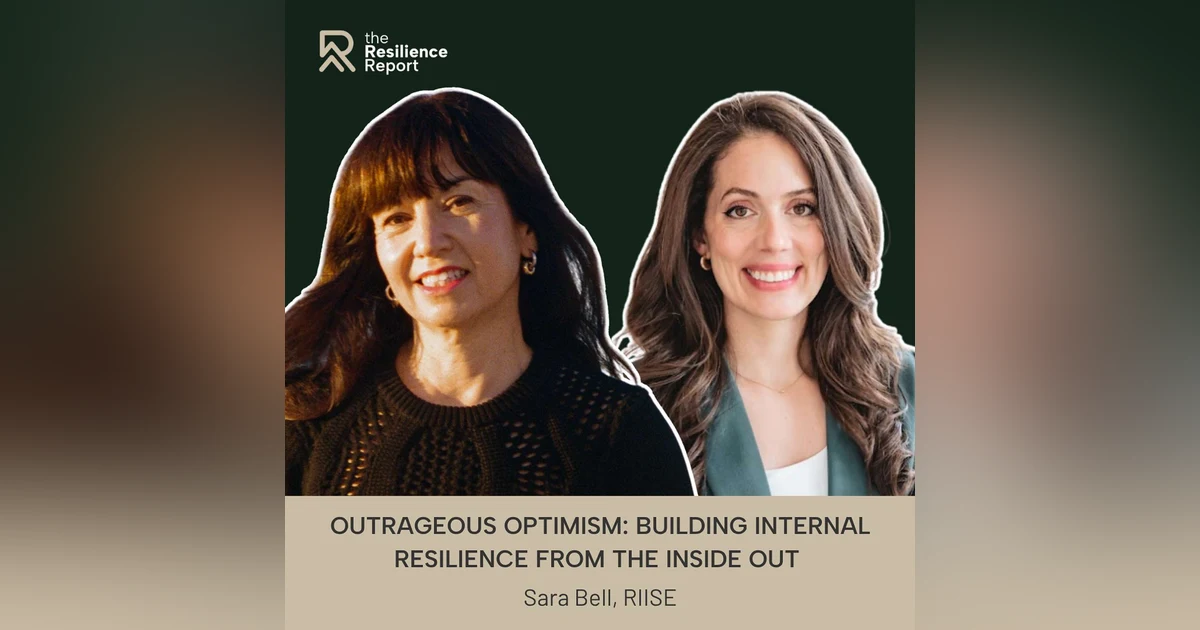

What if the biggest thing standing between you and resilience isn't what's happening around you — it's the voice inside your own head? In this episode, we sit down with Sara Bell, founder and CEO of RIISE, a global marketplace for sustainable fashion and beauty, and RIISE Productions, a film and television company built around lower-impact storytelling. Before RIISE, Sara spent four years taking on fossil fuel subsidies worth billions of dollars in the European Courts — a legal challenge she ...

 Spotify
 Apple Podcasts
 Amazon Music
 RSS Feed
 What if the biggest thing standing between you and resilience isn't what's happening around you — it's the voice inside your own head?
In this episode, we sit down with Sara Bell, founder and CEO of RIISE, a global marketplace for sustainable fashion and beauty, and RIISE Productions, a film and television company built around lower-impact storytelling. Before RIISE, Sara spent four years taking on fossil fuel subsidies worth billions of dollars in the European Courts — a legal challenge she won in 2018.
Sara opens up about the internal work behind that fight: how she learned to change her own inner voice by building what she calls a "mash-up parent" from the words of people she admired, why she believes fear is a tool politicians use against you, and how she moved from being driven by anger to being driven by love. We also get into RIISE's approach to sustainable fashion, why her production company is currently financing a fashion horror film, and what she thinks it actually takes for leaders to be resilient going forward.
Sara Bell is proof that outer impact starts with inner change.
Check out RIISE here: https://riise.world/
My guest today is Sara Bell, Founder and CEO of RIISE, a global marketplace for sustainable fashion and beauty, and RIISE Productions, a film and television company built around lower-impact storytelling.
Before RIISE, Sara founded Tempus Energy in 2012 — and spent four years taking on fossil fuel subsidies worth billions of dollars in the European Courts. She won that case in 2018.
Raised in Sweden, Sara moved to the UK as a teenager, then relocated to Australia at twenty-one, where she still lives today. After becoming a mother, she began the deliberate work of breaking cycles of generational trauma — work that became the foundation for her book, It Starts With You, and the methodology at its center.
Not only did I love this conversation with Sara with her beautiful insights and inspiring impact throughout her career: she was also an absolute angel. When we were ¾ of the way through our discussion, I had the horrifying realization that the recording had failed. Not only did Sara offer to loop back to the top to rerecord, but she gave the same (if not even more) energy and love to each of her answers. Thank you Sara for being such a gift to this world, and now I am so happy to share some of her magic with you our listeners.
*
[Lauren Scott] Well, welcome back to another episode of The Resilience Report. Today is going to be a fantastic conversation because it continues a thread that we've seen with other episodes where some of the strongest, most impactful leaders that we've seen in the sustainability space are those who are multi-hyphenated, meaning that while they've had different chapters or different offerings within their career, there's always been that common thread that really kind of the driving force behind their impact. And today's guest is no exception. So with that, Sarah, welcome to the show.
[Guest: Sara Bell] Thank you very much. It's great to be here.
Lauren Scott: So we are going to jump into all of those different areas of your background, from legal challenges to sustainable marketplaces to sustainable focused production companies. But before doing so, let's start with that common thread that you've seen over the different chapters of your career. Could you share a little bit more about that?
Sara Bell: Sure. I think Steve Jobs said it the best when he said, you can only connect the dots by looking backwards. And I feel that very much about the career that I have had. It makes perfect sense to me and I see the progression, but it might not be obvious to others. But I guess in the last two, two and a half decades, the overriding thread that has gone through all of my work has been climate change and the desire to contribute to lessening the impacts of climate change. We used to talk about solving climate change. I don't think we do that anymore. Unfortunately, that ship has sailed, but there's certainly a lot that we can do in order to mitigate its impacts. And it was that realization, uh, that the impacts of climate change are hitting the people least able and prepared to mitigate those impacts and really wanting to make a contribution, particularly for those people, and they are the people who are getting the impacts of climate change first.
Lauren Scott: And then to to start off, I would love if you could share a little bit more about the legal challenge. And I think that's a world that many of our listeners are not familiar with. So what did that look like in practice? And then how, how were you able to kind of bring the values based work to that experience? Because I think that there is clearly a why behind what you were doing. So if you could share a little bit the reasoning behind it and then the process itself.
Sara Bell: Sure. So I was running an early stage clean tech company at the time, and that company was all about decarbonizing in a way that lowered energy costs for consumers. So the way to do that is to make energy consumers as flexible as As possible so they can use more power when there's lots of renewables in the grid mix and less power when those resources are more scarce. So the UK brought in a scheme to support generation and did not make it equally accessible to customers. So what we ended up doing was challenging under competition law. So we brought a state aid legal challenge in the European Court, basically saying European Commission, you are responsible for competition in Europe and you haven't followed your own rules in approving the scheme. So that's what that legal challenge was all about. But at the time, we were a pre-revenue, pre-investment round early stage company. The board did not support this action, so I had to convince the board We didn't have any money to pay for this legal action, so I had to also find someone who was prepared to pay for it. But what we did was to get, um, a group of aligned environmental organizations around us because it was a competition law case. No environmental charity could bring this kind of legal challenge because to bring a competition law case, you have to be individually and directly impacted by whatever competition failing there is. So we built a coalition of interested parties around us.
Lauren Scott: And to double click into that corporate world. You've shared in the past that CEOs don't have the luxury of being apolitical, that any action or inaction actually does have somebody taking or making a stand in terms of their values, what does that look like in practice and maybe how did you come to that understanding? I think right now in twenty twenty six, we're definitely seeing a lot of people shying away from taking stances. It feels like maybe six years ago there was we're recording this in twenty twenty six. There was a lot of movement. And then now it seems to be the pendulum is swinging the other way. So what does that look like in practice?
Sara Bell: I think it doesn't matter if you're a very large company or a very small company. If you don't stand for anything, your your customers are not going to be there to support you. So obviously, if you're a company, your primary responsibility is to make money for shareholders. So the things that you take a stance on have to be aligned with the company that you're running. When I was running Tempus Energy, it made perfect sense. We wanted as many incentives, as much money to go into the hands of the consumer to reward them for being flexible. And this scheme could have been a fantastic way to to get that money for energy consumers. So that legal challenge was perfectly aligned with the the mission of the company. I think when a brand shies away from an obvious space, I think consumers will punish them for it. So any fear around not taking a stand I think is unfounded. You should be scared or you should be worried. On the other side, and certainly our board was concerned because we hadn't finished a funding round. But what we actually found was that investors were more attracted to us because you're in a space where we were trying to change an industry. If you haven't demonstrated that you have a level of aggression to force that change. Then why would anyone invest in you? It actually ended up being a positive for investors that we were actually prepared to take this action. We basically showed the level of our commitment to this industry.
Lauren Scott: One industry where we've seen certainly that pendulum in particular has been fashion and beauty. And with the marketplace that you've set up, you were kind of taking this head on. How has that perhaps was that part of the why was of setting that up was in seeing those who were making certain claims and not delivering on it? Or was it truly out of a passion project that you were able to establish that next chapter of your career?
Sara Bell: Sure. So although we look like we are a fashion and beauty marketplace, there's a real thought process behind it. Out of the legal challenge, I concluded that we have not done a good enough job at selling human beings on what a climate friendly lifestyle looks like. We have treated human beings as some kind of idol idealized person instead of actually approaching each human as they truly are. You know, we are full of contradictions. We are sometimes lazy. We are sometimes selfish, we are sometimes thoughtless. But we are also sometimes very loving, sometimes really rise to the occasion, sometimes incredibly thoughtful to other people. We are all these different things. And if you try to guilt and shame a human being into changing their behavior, you will not succeed. They will feel crap about themselves, but they won't change their behavior. And so therefore, those kind of approaches are a complete waste of everyone's energy. So we set up RIISE really to to show that a climate friendly lifestyle can be incredibly beautiful, can be very desirable, and is one that you want. And we started with fashion because that's probably one of the easiest ways to show that and to show beauty in all its forms.
Lauren Scott: And another super creative way that you are being, that you're showcasing what's possible is through the production company. Could you share a little bit more about that? Because I think we don't really realize the value of the content that we're consuming. And there is such a creative way to weave in this more positive impact element to that. So could you share a little bit more about the production side of things as well?
Sara Bell: Sure. So our film and TV company, we create projects that are basically nothing to do with climate. I think the time to educate people on climate has passed. If you want to. To reach as wide a population as possible. So we make entertainment. But inside that entertainment, we very subtly show a climate friendly lifestyle and make it very desirable. So, for example, when I'm currently in the process of financing a fashion horror movie, it's basically a vampire movie. Inside there is a fashion show in the outback. That fashion show will be absolutely stunning. Uh, but is all sustainable fashion. The wardrobe that all these beautiful people are wearing is all sustainable. No one's drinking from a takeaway coffee or from a plastic bottle. Uh, all the all the cars are electric vehicles. So we're basically just creating this very, very luxury world inside this film. But all of it is sustainable. And the message in there is basically the world that you either live or desire to live doesn't actually look that different to what we're showing you on screen. So the leap is not that big of a leap.
Lauren Scott: I love that intersection of vampires, fashion, and sustainability. It is very, very creative. Well, in chatting with you, it really feels like something that you've truly understood the value of is the human psychology behind change. And you've had work in multiple different markets, having been born in Europe and then done work in the U.K. you're now in Australia, you've done work in Singapore. Do you see any common threads when it comes to the human psychology and approach to sustainability from within those different markets, or are there any common threads?
Sara Bell: Sure. I think the the level of economic progress that a country is experiencing matters massively to whether someone has the ability to to focus on environmental matters, like from their own point of view. So that's definitely something that just has to be realized. And I remember during Cop twenty one, at one of the sessions, the the managing director or CEO of Marks and Spencer's spoke in this panel. And one of the things that he said was that people should be demanding renewables. People in India should be demanding renewables. And that's just complete nonsense. Many people in India should be demanding food, safe shelter. Like you can't try to get people to act, to agitate for things that were before their basic human needs have been met. So I think those kind of ideas are really not very useful. Um, within countries that have experienced a lot of economic development. It still varies quite a lot depending on the sort of introduction to nature and the environmental values they get as children. So I grew up in Sweden, where you get a lot of exposure to the importance of the natural world. Um, and it's not presented as in business is one side, the environment is one side, the two are together as indeed they are in the real world. When I lived in the UK, that was not the case. And the kind of the reverence for nature wasn't the same. And I think that definitely impacts what people grow up with. Um, so I think countries can do a lot in the early years to solidify those environmental values.
Lauren Scott: Part of the psychology or the the wheel of emotions, certainly there are these elements of fear and outrage. And you've also shared publicly that you feel like those two elements in particular are being leveraged, both from a economic model and certainly a political model. Where did you come or how did you come to that realization? And do you feel like there's anything or any lens with through which our listeners can approach the content that they're consuming and knowing this information.
Sara Bell: Sure. I think in the last fifteen, maybe twenty years, the number of politicians who are prepared to use fear for a very simple electoral approach has definitely grown. A very typical one is immigration pushing the narrative that immigrants are taking your jobs. Uh, in fact, uh, automation is probably the biggest villain in that process. Every economic survey that has ever been done has shown that immigration has a zero or positive environmental impact on a country. So those those those statements by politicians are absolute nonsense. Uh, but they are pushing your fear button. And I have done a great deal of internal work, and some of it was around fear. So I'm probably, I probably have thought about this, uh, more than perhaps others would. But the thing that strikes me immediately is the way you can tell if someone is not working in your interest is very easy. If they are making you scared, then they're not working in your interest. Every time your fear button is pushed by a politician, that should be a red flag that actually it's in their interest, not in your interest. Because if it was in your interest, they would be trying to make you feel reassured, happy, comfortable when they're trying to provoke a negative reaction. They are using you for their own purposes.
Lauren Scott: There's such an important lens, and I have moved over the past year from North America to Europe, and certainly I thought at the time that it was primarily a North American thing. Even within Canada, but obviously more broadly in North America. But I'm certainly seeing it. It's a. It's interesting that it's the same narrative everywhere of trying to push that. Those fear buttons. I think there is so much work that needs to be done externally. Obviously, we see there's a huge space to have that positive impact. But you've also spoken about needing to balance that internally with the external side. Somewhere in the middle of everything that you've been doing, you manage to find time to write a book about this. And really, it starts with yourself and how you can find that balance between the two. So could you share a little bit more about what drove you to share more about this, and why you think it is so important for those who are working in the impact space?
Sara Bell: Sure. So around the beginning of last year, it suddenly struck me just how profound the change in me had been. And that was really why I decided to write the book because the methodology that I had created by trial and error had been so successful in creating change in me that I wanted to share it so it could benefit as many other people as possible. Um, I think the, the strength that you get from having sorted your inside is just phenomenal. Um, all of us have a voice in our heads. If that voice is supportive and useful, it propels you forward in life. Uh, if it's negative and unhelpful, it massively holds you back. So the task of changing your internal voice, I think is a really, really important one. I think of that internal voice as my internal parent and I changed it by creating a mash up parent from lots of, um, statements and ideas of other people. I think we're in a self-help book tells you to reparent yourself or to just change without giving you the tools to do so. It's not very helpful. So I kind of came upon this, I guess, just from trying a few things out. So for example, um, Maria von Trapp in The Sound of Music when she sings a few of my favorite things, her words are not how I would speak to myself, but that has mutated into, um. Think of the things that you love. And that's a true, authentic me internal voice. So by anchoring on other people's words, you can actually change. Because if you're anchoring on your own already imperfect internal voice. It's very hard to change. So that idea of a mash up parent has been really important, um, uh, to, to create the change. But I think don't underestimate the extraordinary benefit of being in command of your own mind because it's a game changer. It totally changes how you approach life.
Lauren Scott: I think that's such an important work to happen to be able to do that. Do you feel like that's what's maybe supported you in those moments where you're doing values based work and you come under pressure, you really are truly believing in what you're trying to do, but then that outside force just seems so strong. How perhaps, have you had any of those situations where it just felt so overwhelming, and it maybe had a different kind of reaction within your own storyline?
Sara Bell: Sure. So I am incredibly determined. Um, and that is because I had an insane childhood. Uh, I always think that entrepreneurs are either born or made, and the ones that are made are generally made from insane childhoods. Uh, so when I've wanted to do something, so for example, the legal challenge, of course, it was incredibly difficult because I had to keep an early stage company alive for the period of that legal challenge. But the legal challenge actually helped because it was such a, an important thing to do. Uh, the scheme was so outrageously awful that someone had to fight it. So that helped to drive me on. Uh, but I think if I really reflect on that period, I pushed myself because that's how my childhood was. I would do it differently today, but I would still do the legal challenge because it was the right thing to do. We changed the course of European energy policy. I wished we had been able to do more, but that doesn't in any way discount just how much we achieved.
Lauren Scott: And do you feel like that is the same engine behind you now as you continue to build and continue to grow? Where do you feel like that source of determination comes from? Is it one singular thing or do you feel like it is maybe a plurality at this point?
Sara Bell: So I think, um. With climate change, the, the act of working on a very complex problem and is interesting in and of itself. It's not all kind of worthy reasons for doing it. I am absolutely fascinated by this work. It's incredibly complex, so it really stretches my creativity, my intellect, and it's actually perfectly fine to go into a field for all of those reasons. Like I hope as many people as possible come into the field because they want and they want that challenge. But I think for myself, um, and I guess this is probably part of the internal work that I have done, um, that a life needs to be lived for a combination of yourself and others. If you live a life only for yourself, that's not a very satisfying life if you live a life only for others, that's also not a very well balanced and happy life. So once you have done the internal work, it's a lot easier to ensure that you are supported by yourself and then you can support others. So although the, the, the interest and desire is exactly what it's always been for me. I want to see action on climate change. I want us to limit the impacts. I want us to regenerate this phenomenal planet that we're so fortunate to live on. But the how has definitely changed. And in. I would never say I was led by hate because I'm just not that kind of person. Uh, but I was probably led by anger, um, as well as that desire for change. Now I am led by love, and that emotion is so much more renewable in every sense of the world. And so if you want to have a way of moving yourself forward and keeping keeping your energy tank full, I think love is the most renewable source you can ever find.
Lauren Scott: So we have many of our listeners who are in this values based work, and they are trying to find different ways for them to be able to continue to come back to the work. And oftentimes it's little things like little different tips and tools. Have you found any for yourself over the years that have allowed you to keep on coming back to the great work?
Sara Bell: So I think the fundamental thing that has changed for me is the work that I have done on myself, because I am completely in command of my own mind. So previously things would pop into my head. Negative things. Oh, this is hopeless. Oh, this is not working. Etc. etc. I am now capable of stopping it at the first word. So that's an incredibly helpful thing. So getting in command of your mind I think is very important. And the other thing, and it's a major part of the RIISE brand is optimism. Outrageous optimism. And that is an energy force in and of itself, and especially in the climate space where things can seem very hopeless. You have to find things that create the optimism for you that you can keep coming back to day after day, because that hope and optimism is the thing that can keep you going. And do not underestimate what an extraordinary force that is and how that attracts people to you so that you can build a movement.
Lauren Scott: And if our listeners would like to learn more about your incredible fashion marketplace and the production company. Where would you recommend that they go and check out?
Sara Bell: So RIISE is a global e-commerce marketplace. The website is RIISE with two "i"s dot world. And there you can also find editorial articles about sustainable fashion and other lifestyle, um, lifestyle matters. My book is also sold on RIISE. My book is called It Starts With You because it does and it's part memoir, part self-help manual, and is the process that I have put myself through. I haven't included any of the things that didn't work, but I've gone through a methodology for how I have created the change in myself. There are a lot of self-help books that will simply tell you you need to change. You need to reparent yourself. You need to change your internal voice. But you can't do that without anchoring on something. So I came up with this idea of creating a new mash up parent in my head. So I would put together the words or phrases of various different people, and then fuse it into a voice that was my own. It happened over a few months, and by anchoring on the other person's words, I was able to change my own words because obviously they were different to my internal voice. And I think that process of creating your own mash up parent inside your head is very important for, for driving that change inside.
Lauren Scott: And then finally, we like to end every episode with the same question. I would love to know your thoughts on this is, what do you think it will take for businesses and leaders to be resilient going forward?
Sara Bell: I do think not to harp on about it, but the internal space you occupy is everything. It's what you end up projecting out because it's what's real for you. So to be resilient, you have to start from the inside out. Once you have received, once you have created your own internal resilience, everything else becomes so much easier. Like things don't bother me or have much impact on me anymore because I'm so in command of what's going on inside me. So I can just bat these things away. And I think I have been a resilient person for a very long time, but for a long time it was actually only on the exterior, and I seemed like I was an incredibly tough person. I seemed like I was able to handle so much, but a different story was actually going on inside of me. Now all that strength is actually really strongly anchored inside, and the external matches the internal. And when you get to that point, you are so unstoppable. It's an extraordinary position to be in. And so I would really say that you need to do that work because you won't even be thinking about resilience for yourself once you've done it, because it will just be natural.
Lauren Scott: Thank you so much, Sarah, for this conversation. It has been fantastic.
Sara Bell: I think what you're doing is really amazing. I think resilience is actually so important. It's been lovely to talk to you.