How a 30-Year Ad Strategist Rebuilt His Career Around Indigenous Language Reclamation ft. Jef Combdon (MarkerTree)
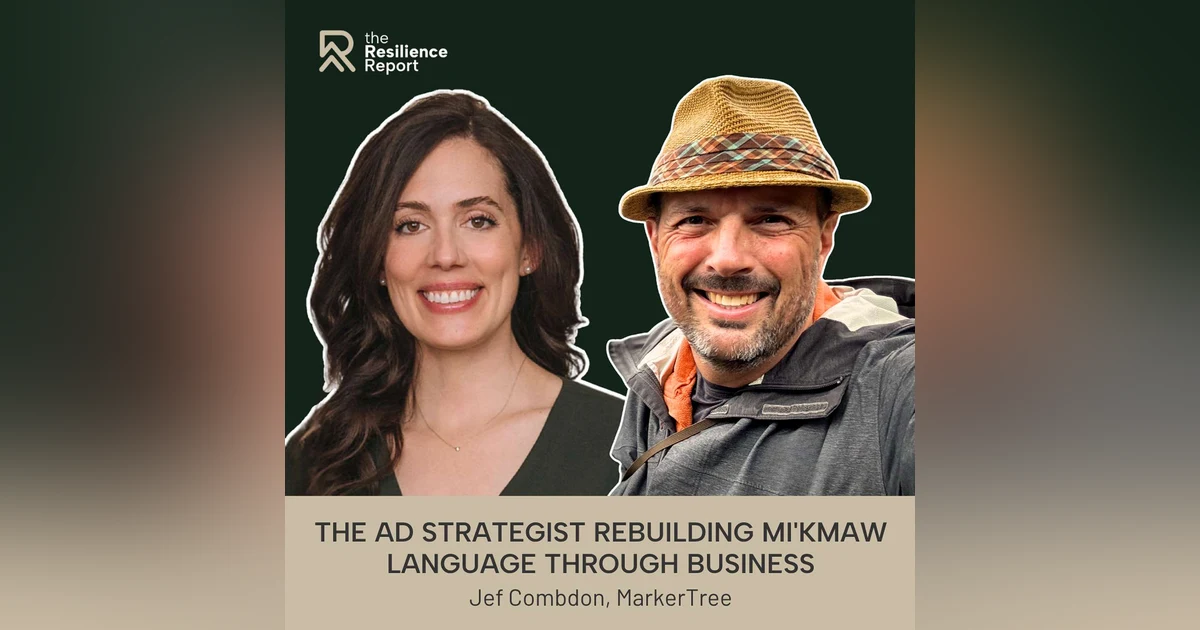
This episode's is someone I've wanted to sit down with since the very early days of this podcast — and trust me, the wait was worth it. Jef Combdon is a 30-plus year marketing communications and media strategist who has built campaigns for some of Canada's most recognized names: Molson Coors, Kraft, Colgate, Maple Leaf Foods, and Newfoundland and Labrador Tourism, among others. He has operated at the highest levels of both holding companies and independent agencies, across Toronto and St. Joh...

 Spotify
 Apple Podcasts
 Amazon Music
 RSS Feed
 This episode's is someone I've wanted to sit down with since the very early days of this podcast — and trust me, the wait was worth it.
Jef Combdon is a 30-plus year marketing communications and media strategist who has built campaigns for some of Canada's most recognized names: Molson Coors, Kraft, Colgate, Maple Leaf Foods, and Newfoundland and Labrador Tourism, among others. He has operated at the highest levels of both holding companies and independent agencies, across Toronto and St. John's.
And then he walked away from all of that to build something entirely his own.
MarkerTree is Canada's first and only social enterprise in the marketing communications space — a company with two mandates built right into its DNA: deliver exceptional outcomes for clients, and use the profits to fund Mi'kmaw language reclamation. Jef is a proud Mi'kmaw and active member of the Ktaqmkukewaq Mi'kmaq community, and he co-founded the Ktaqmkuk Mi'kmaw Fluency Project — an online and immersion school working to bring fluency back to Newfoundland, where it had all but disappeared.
What does that mean for you, listening right now? Whether you're an entrepreneur questioning whether your work is aligned with your values, a leader navigating what reconciliation actually looks like inside a business, or someone who has ever had to choose between getting ahead and being fully yourself — this conversation will stay with you.
Learn more about MarkerTree: https://markertree.ca/
My guest today is someone I've wanted to sit down with since the very early days of this podcast — and trust me, the wait was worth it.
Jef Combdon is a 30-plus year marketing communications and media strategist who has built campaigns for some of Canada's most recognized names: Molson Coors, Kraft, Colgate, Maple Leaf Foods, and Newfoundland and Labrador Tourism, among others. He has operated at the highest levels of both holding companies and independent agencies, across Toronto and St. John's.
And then he walked away from all of that to build something entirely his own.
MarkerTree is Canada's first and only social enterprise in the marketing communications space — a company with two mandates built right into its DNA: deliver exceptional outcomes for clients, and use the profits to fund Mi'kmaw language reclamation. Jef is a proud Mi'kmaw and active member of the Ktaqmkukewaq Mi'kmaq community, and he co-founded the Ktaqmkuk Mi'kmaw Fluency Project — an online and immersion school working to bring fluency back to Newfoundland, where it had all but disappeared.
What does that mean for you, listening right now? Whether you're an entrepreneur questioning whether your work is aligned with your values, a leader navigating what reconciliation actually looks like inside a business, or someone who has ever had to choose between getting ahead and being fully yourself — this conversation will stay with you.
Please welcome Jef Combdon.
*
(Host: Lauren Scott) Welcome back to another episode of The Resilience Report. I'm personally really excited for this episode, because when I started the podcast three years ago, I had a handful of people that I wanted to eventually get to speak to, and our next guest was one of those individuals. I think I was waiting to get the podcast into the right state to have this conversation, and in parallel, this individual has also had different experiences and kind of expanded his own work that I know our listeners are going to learn so much from today, so with that, welcome to the show, Jef.
(Guest: Jef Combdon) Well, thank you. I'm looking forward to it. You know, it sounds like it's gonna be an exciting conversation.
So you've spent over 30 years of your career working at building some of the biggest brands in the Canadian world, if you will, from Molson Coors, KFC, beautiful campaigns for Newfoundland and Labrador. And yet, over the past few years, you decided to pivot from that space, despite having all the success, and to something that was really close to your heart. Can you maybe speak to that transition, and was there a moment in time that made you kind of jump towards that transition, or was it more cumulative?
Okay, perfect. It's a great question to kind of kick things off. My origin story for MarkerTree. I would say, you know, so I started MarkerTree almost 2 years ago. Let's just say 2 years, rounded up. And, you know, at that time, it felt like I was making a sharp right turn. Even compared to some of my earlier career aspirations, it felt like an about-face, like, you know. I never desired to own my own company. I never, you know, it was always, I just wanted to work, I wanted to climb my way to the top of the ad business, and, you know, work for a big, well-respected agency.
But time has a way of flattening things out, like, you know? And so now, even when I look back two years, it's sort of like… it doesn't seem like such a sharp turn. It seems like it's just a bend in the road that my career trajectory has been kind of going along.
So, to get at your question, it's really like, when I started in advertising, all of my early mentors really impressed on me the importance of committing to the industry. And they said, if you want to go somewhere in this business, you need to commit. Fully commit to it. And, I did exactly that. And it's an industry where you kind of have to. Because not only do you need to become an expert in your craft, right? If you're a copywriter, you need to be a great writer. If you're an art director, you know, do that bit. And I'm a strategist and a planner, so I have to hone my craft to become good at what I do, but you also, you know, you need to stay on top of your industry, and ever since the birth of the internet, this industry changes every day. So it's a lot of staying on top of.
But that's also compounded with the fact that you need to become an expert in your clients' businesses. And so, yeah, so you mentioned, you know, Newfoundland Labrador Tourism, Molson Coors — over the span of my career, I've had to become an expert in the automotive industry, the beer industry, the spirits industry, pharmaceutical industry, it goes on. And it doesn't leave a lot of time for anything else. And that's where that's the commitment. And so you sacrifice all your personal desires in order to get ahead in this business. And I think over time, it was just more an act of me wanting to pull back a little bit, and be a little bit more Jef, and be a little bit more true to what I wanted to do.
And yeah, so I, you know, there's a few steps that I've made that have led me to this point where I'm at now. And it did come to the realization that I wasn't getting enough of my 5 to 9 of doing good. I wanted to do more good in my 9 to 5, and the only way that I could see in my current situation to do that was to start my own business. And even within that, to find, not just start my own business, but structure it a little bit differently than everybody else. And that's what led me to setting up MarkerTree as a social enterprise. Because within that model, you know, you can effectively serve two masters, right? Ultimately, every other business, you really just serve one master. Like, you know, if you're an agency that's owned by a holding company, you serve the shareholders, and that is it. If you're working at an independent agency, you're serving the owner who owns that business, or the leadership team who may share in the spoils of that. Whereas with a social enterprise, it's okay, you know, I serve my clients, but I also serve the cause that is important to me, and that's what motivates me to kind of get up every morning and get back into it. You know, take that extra time to stay on top of the crazy world of advertising.
I'd love to double-click into the social enterprise side. We've had a couple of guests on who have been in that space — some in the financial area, others more in the consumer goods space — but never really in this side. And I'm curious specifically around where you're going with this organization, because you've dedicated 51% of profits to Indigenous language reclamation. Could you speak a little bit more about that, and what that even looked like in setting that up for MarkerTree?
Yeah, it's… and that part is still taking shape, and what it's going to become is still on the horizon. But yeah, starting with the number 51, it's kind of a magical number for me. It's a lucky number. It's a number that, ever since I was probably 5, I really gravitated to it. Like, you know, hockey jerseys, BMX racing, etc. It was always there. So even to this day, if somebody knocked on my door looking for a pledge for a skate-a-thon or something like that, I always give $51, or $51.51, or something like that. And it's a way that I pass on my luck to them, so they could do better.
But within the business, that 51% — to dedicate 51% of your profit to something is very significant. Like, you know, everybody talks about not having big margins and struggling to get by, and I'm just going the opposite direction, and taxing that even more. And I feel, you know, why that is important is, if it's more than half, then it holds the keys to the decisions, right? And, like every business, right now, April is the last month of my fiscal. And I might be looking at my numbers and saying, yeah, you know, I've got some money, I could maybe invest in this or pick up this. But I always stop and weigh that, say, well, hold on, that is going to cut into my profit for this year. And that is where my fund is coming from. So, is that the right decision? Is it the right decision to get that new laptop? Will it pay for itself? So it just becomes a little bit of an extra decision-making process for me to keep me focused on language reclamation efforts as being the priority for the business.
And then on a personal level, I've always believed that when you give, if it doesn't hurt to give, you're not giving enough. You know, and that's kind of always been something that's guided me from day one. It's kind of like, you know, anytime I'm giving to a cause, I give big, and I have to go without in order to give, and that's when you know you're giving enough. So, I wanted my business to kind of embody that.
As businesses are thinking about having that positive impact, I know that you've been pretty open that when it comes to reconciliation in Canada — for listeners who are not from Canada, there were a number of efforts done at a federal level, certainly within businesses, maybe about 5–6 years ago, where there was an increased emphasis — I cannot necessarily speak to where that stands today, it seems like a lot of companies were paying lip service, and maybe were not… their DEI commitments were not necessarily having the necessary impact. If we have listeners who are tuning in and they would like to maybe take those steps in the right direction, especially maybe when it feels less trendy now than it was 6 years ago, and I assume all these companies were jumping on the bandwagon, do you have any guidance there as to where they can do additional research?
Yeah, you know, I'll first say it's sad to see the pendulum swing back as far as it's going on DEI, because I think it's very critical. Even for the people on that spectrum who are villainizing it, it just doesn't make sense to me. It's like, you know, why don't you see strength in diversity? Like, you know, if you're gonna build a hockey team, you don't build a hockey team with only defensemen. You need people who score, you need people who see plays and set up plays, and you need everything. And that's really what the strength in diversity comes from — having people of different perspectives contributing to something, as opposed to 8 people with the same perspective just doing the same thing.
So it's sad to see where it's gone. But when it was on trend, and this is even prior to me starting MarkerTree, and that's when I started to become a little bit more vocal — I didn't want to see the obligations of what Canadian businesses have to First Nations people be rolled into DEI. Like, you know, it's a separate, completely separate thing. If you have a business that either is from this land, or is operating in this land, like there's lots of global companies that are here, you have a responsibility to the First Nations, the Indigenous people of this place, right? The system that allows you to excel is the same system that crushes, you know, the original people of this land. And so, yeah, as part of the truth and reconciliation, the calls to action, number 92, it is, you know, on the responsibility of Canadian corporations to further reconciliation with Indigenous people.
And that was why I was very vocal about that when DEI was kind of on trend and getting talked about. And Indigenous stuff was being rolled into that, but it's sort of like, no, but you need to separate those two. And I believe there's a very positive solution for reconciliation, that doesn't have to be like a tax, it doesn't have to be like a handout, or even a hand up. It can be structured as a win-win. Because when it's a win-win, then that becomes sustainable, right? So yeah, when I started MarkerTree, I actually seen this as an opportunity where I could lean into that and help businesses navigate that space, and create a reconciliation program that did achieve a win-win.
But for me, it's a really, really challenging line of business to pursue. Because, you know, unless you're a company that's involved in resource extraction, there's probably no businesses in the country doing anything significant with Indigenous people to date. And in the two years that I've had my business, I've learned that, yeah, you know, business doesn't care. Like, it's just part of the societal fiber that we're part of right now. But yeah, it is a challenge. So I still try to impress on others that we have a responsibility towards First Nations people and Indigenous people. But yeah, it is a really challenging space, and I just didn't want to see it get absorbed up by DEI. And ultimately, it's just sad to see where things are shifting back to.
I completely agree with that pendulum observation, even, I'd say less so probably here in Europe at the moment, but certainly on a global scale. As part of those challenges, I know you and I have chatted about sometimes having to step away from something, or say no to something, because it's not necessarily in line with what we're trying to achieve, personally and professionally, and certainly not in line with our values. Have you had that experience within MarkerTree, or even prior to then, where you realized that, you know what, this is a great opportunity, but it's just not right for me?
You know, prior to MarkerTree, I couldn't do anything about that. Like, you know, it's sort of like, I work for somebody else, and it's hard to impart your values onto an organization that's not yours. And so, all you try to do is you find organizations that align with your values, and you hope that they continue to align with your values, and you hope that you could probably steer them gradually, but usually those values center around your core business offering, right? So I would align with agencies that believed in quality. I would align with agencies that believed in not robbing their clients. Those types of things. But for other values, it's sort of like, yeah, you just gotta park that. Which is unfortunate, but that's why I started MarkerTree. So I could — I'm driving the bus now, and so I create the rules.
And, so yeah, but I've only been in business for 2 years, so I haven't had a lot of opportunities. Most of the time where I can't work with somebody is because it's just a misalignment. They reach out looking for a logo, and it's like, well, I'm more the brand behind the logo — the thinking, the strategy, you know, not what you look like. But when I did start MarkerTree, I had a couple of companies that I had to say no thanks to. And that's because of another issue — in Canada, you know, there's a federal government procurement policy where 5% of all government dollars need to be spent through Indigenous businesses. And that whole system has just been horribly managed. It's wrought with fraud. And when I first started up MarkerTree, I had a couple of immediate potential clients that reached out, and they just didn't smell right to me. They just didn't seem right — are you looking for me to legitimize you so you can go after this money? And so, you know what? I don't want to go there. No thanks.
You know, and there were a few telltales, like one business wanted a Migamaw name, and they didn't care about the meaning of the name. It's like, come on, really? Like, you just want something? You're just checking a box? And yeah, so you could kind of ferret out the box checkers, and the people who are doing something that's meaningful. Like, it is very complex. Indigeneity is very complex, especially in the whole pretendian stuff, right? I'm mixed race, but I identify as Mi'kma. I am Mi'kmaw. But that brings complications, right? And so a lot of settler businesses don't understand those complications. But yeah, I haven't had to turn down too many. It's just kind of the initial bit. Even with that, everything's cyclical, right? The fraud gets exposed in that system, and then the fraudsters move on to something else. That's the unfortunate reality of the world that we live in.
If we rewind a little bit to when you and I were originally crossing paths, it was between 15 and 20 years ago, in the advertising media space. I remember at the time, sustainability more broadly, which is where my interest was, was not necessarily a big part of the conversation. To your point, I feel like it maybe ebbed and flowed a little bit. Where do you feel like that industry is today, in 2026? Do you feel like there was any more intentional alignment to have that values-based alignment, or do you feel like wherever customer trends are going is necessarily where they have to go, especially with those thinning margins in, I'd say, the past 4 or 5 years or so within that space?
I don't… you know, it's a tough one to really answer. I think you could look at everything, and you could say everything could do better. Like, you know, like, everyone could try better, and they could do better. Within the ad business, I don't think that a lot of companies, a lot of agencies, really embody anything other than, I'm here to make money, or I'm here to do great work. Those are the two things that motivate those agencies, right?
It is an industry that's dominated by holding companies, and that has brought a whole host of problems to the industry. And I look at those companies, and I say, you could do a lot better. Because when you really boil it down, I look at holding companies almost like colonizers, right? They are designed to extract wealth and exploit labor. Every client who works with a holding company-owned agency, that's what they're working with. And when your business model is that, you need to do a lot more. And you need to do a lot more than give your staff the afternoon off so they can go pick up garbage. Because that's what you usually see on LinkedIn being shared — or we went bowling and we raised some money. They're nice things, and I don't mean to poo-poo that, but it's like, no, you could embody something better and bigger than what you're doing.
But then on the flip side, where agencies really do play a role within the cause space — they help make causes famous. Some of the best work in the industry is cause-based. And the reason why it's the best is because the creative agencies have got a little bit more creative control over what's being said and what's being done, and they realize that you don't have a lot of money, so you need to break through with this one impression. And so there's some wonderful ad campaigns out there that are all very memorable — SickKids and so on. And so as an industry, I think the industry's doing well within its sandbox. But I do think from a business side, the industry could do better. And we could all do better.
And my starting MarkerTree wasn't like, oh, I want the industry to follow and become more cause-focused. But it is a realization of, you know, what is their core role? And if their role in all this is to help make those causes more famous, then okay, great, let's lean into that. I try not to be too judgy in life. I try to see things from both perspectives — a Mi'kmaw principle, a duoptimum, because two-eyed seeing. I like to see things from both perspectives, and try to find where's the good and where's the bad in that.
I appreciate you bringing that lens, because I think I maybe am a little bit too jaded, but you're right — from a cause-based perspective, there has been incredible work that, having been involved in nonprofits, you just typically don't have the budget, so you need that high impact. You're absolutely right. And as we think about having that positive impact, it really takes a shift from thinking about next quarter's earnings, and thinking longer term into future generations, even past generations. We've had a couple of guests in the past discuss the 7th generation principle, which does embody elements of that, but I would love if you could speak to the concept overall for our listeners who are maybe less familiar, and any iterations of that that really speak to you.
So first, to give credit where credit is due, the 7th generation principle is not Mi'kmaw — it's from the Haudenosaunee. The Haudenosaunee, who are also known as the Iroquois Confederacy, is — I think it's 5 or 6 different First Nation groups — came together, sharing a common language, to be a stronger entity. And because they're representing six different perspectives, they had to formalize more of their decision-making. So they came up with the 7th generation principle.
It's one of those things that, from an Indigenous perspective, gets adopted by other Indigenous groups and people — partly because it aligns with your worldview, and it's a good articulation, so why not, right? And so the seventh generation principle, to put it simply, is when it comes to making important decisions, you don't look at just the impact it's gonna have today. The wild part is to think, how is this going to impact the next 7 generations to come? And that's what should guide your decision-making. Which is a really refreshing way to look at it, especially in the drill, baby, drill world we're living in right now. That decisions could be made with that much foresight. We're living in a world of short-termism, and that is part of the problem that's swirling around everything.
And it's just a wonderful principle, and just to power that up even more, many First Nations groups and people, including the Mi'kmaq, believe that time isn't linear, it's cyclical. And so those decisions not only should be made to think about the next 7 generations to come, but also to think, does this respect my ancestors? Does this respect their wishes, and what they wanted to see? And when you work that into your decision-making process, you can only come out with good decisions, as opposed to, you know, drill, baby, drill.
It is a catchy campaign, though, but… I do love that, kind of, looking forward and the bigger vision. We do have a lot of listeners who are entrepreneurs, and who are trying to disrupt their respective industries, and it's not always easy. I think the vision that we have for what we're trying to accomplish, and then the day-to-day reality, it can often feel like there's an important gap between the two. You've been really honest in chatting before this, that you feel like maybe MarkerTree has taken a little bit longer to hit its stride, or that it's been a little bit more challenging, perhaps, than you had expected. If we do have listeners who are maybe just embarking on the entrepreneurial journey, are there any learnings, especially from the early days, that you would want to share with them?
Yeah. You know, I kind of hinted at something earlier, and it was sort of like, for me personally, and this shouldn't really have been a surprise. But, you know, you get caught up in the momentum. And, you know, you mentioned DEI, and there was some good momentum when I came into the market. And then it kind of — I came back to the same realizations — oh, businesses don't care about Indigenous people. Businesses don't care about social enterprises. Like, you know, it's a nice thing, but it's not that they dislike it — it's just, businesses are making decisions that impact their bottom line. They impact the life and sustainability of their business.
And so I guess, you know, the realization is, okay, I'm not for everybody. And I have to acknowledge that. I'm not going to be for everybody. And so I'll try knocking on as many doors as I can, but I'm not going to be thrown off by getting the door slammed in my face. Just keep focused on trying to find the right people that you are for. And try to make a difference there. So I think that's probably the biggest universal takeaway. No matter what your drive is for — for me, it's about Indigenous culture and reclamation — it's powerful and personal to me. But you're in a business setting, and so you have to acknowledge that that passion exists with you, and it might not exist with the clients you're trying to convince to work with you.
So you still need to do a good job at your core offering. And even though I'm Indigenous, it's an Indigenous business — working with me could also be, you know, an effort of reconciliation. There's a lot of good things, and to know that your money is gonna go towards helping fund language reclamation. But, you know, at the end of the day, it's still about business. So you just gotta keep trying to find who you are good for, and not to be discouraged by it. Because for me, even though it's only been 2 years, there's been moments of, ugh, why me? And I just got up the next day, and kept trying.
Part of that journey, as well, you've mentioned possibly contemplating another offshoot with Indigenous tourism. I think this is such a fascinating angle, one which I'd never admittedly thought too much about, but I could see huge interest in this, and one way, in particular, I've been reading a lot about how what this next generation is going to be craving is in-person experiences — that we're all kind of fried from being online, we want to connect with community, we want to learn in person — so I see that being such a beautiful extension and needed in this space. Could you share where this thought came about, and then where you're hoping to go with that as part of broader reclamation efforts?
Yeah, absolutely. It dovetails nicely with the flow that we're talking about here. It's part of my realization. It's like, okay, well, it's difficult for me to really raise the money that I want. I can only scale myself up so much. I only have so many hours of the day. So, it's about finding, well, where can I get more margin? So if business doesn't necessarily care that I'm a social enterprise, or they don't necessarily care about my cause, or who I am, or whatever — who does, right? And it's about finding your market.
And fortunately, in my ad world, I've been involved in the tourism industry for the last 14 years. And living here in Utahong, Newfoundland, I'm very active in, sort of, the core tourism product that exists here — it's hiking, it's nature, which also connects with me culturally. So it's kind of like that win-win that kind of just presented itself, to say, hey, I wonder, from a social enterprise perspective, from a language reclamation perspective, from reconciliation, and just from knowledge — people want to learn about other cultures, and heck, cultures from the place that they may live. You know, it just seemed like a perfect extension for me.
So yeah, I'm kind of in the process of building that up and piloting that business, and this summer is my plan to really kick off that pilot to see, can I make more money for my cause in that space, by going straight to consumers? Because consumers on vacation, who want to learn, who want to learn a new culture, a new experience, to feel enriched, to learn about a little bit of history that's not told — yeah, they might find that to be a strong offering. And then, frankly, if you go back to your very first question about me and my career trajectory, I've been bit by bit pulling back a little bit more Jef, a little bit more Jef, and that potentially could be the destination that I'm actually working towards — offering kind of a guided hike experience where I teach people traditional medicines and history. And the nuances of colonialism here in Newfoundland is very different than the rest of Canada, so that story needs to be told. And I just think, yeah, there's just a great offering there.
And my company's goal is to raise money for language content creation. Well, you know, I might be more successful in that space than trying to convince, you know, the General Motors of the world that they should be working with me.
So it's a little bit of a pivot, but it might not be. Like, it just seems the way that it's moving. Just to double-click into that for a moment too, because you shared the other day — for our listeners, follow Jef, his content is phenomenal — you were sharing about the words that are used within the Mi'kmaq language, and how closely they are connected to nature. It almost feels like there's a natural extension, too, and I was sharing that I find it so hard to express how important and how connected I feel to nature in English or in French, but you were saying that there's actually a very beautiful thread you can pull there.
Yes. You know, it's. I think that what you're touching on is actually part of the spark for me to learn the language. Part of it is, it's a culture that — it's something that I didn't have the opportunity. It was taken from me to learn. So it's about taking it back, like, you know. But it's also a little bit of preservation, because for a lot of languages, words are just words. But the more I learn Mi'kmaw, the more Mi'kmaw words I learn, and their root words of where those words came from, it's just like they hold a little million aha moments.
And everything links back to nature. Almost everything links back to nature. Like, you know, like, the word sesubeg means it's slippery. So if I was out hiking with, you know, my wife, and it's a little icy — which in Newfoundland, we live with a lot of ice — I might say sesubeg. And that's, you know, hey, careful, it's slippery there. But the root of that word actually came from observing otters going into the ice, like, and so you knew that's where they went in, but they didn't come back out, because it's slippery. And when I learn little things like that, it's like, wow. You know, these — the generation that knows this knowledge, and it's very sparse — they're passing. And that's part of what I think puts a little bit more urgency on learning the language, either myself or helping others learn the language, because the more that we learn it, and the more questions we ask, the more opportunities we get with an elder to understand the meaning behind those words. And how they constantly remind me of how connected we are with nature.
You know, there is a Mi'kmaw phrase which means, all my relations. And a lot of Indigenous people will say, all my relations, and what it really means is that we believe that all living things are interconnected. And that's a really good principle that just helps really kind of ground you as to where we are and where we come from, and it's all nature. So yeah, when I learn the language, I feel very connected to nature, I feel connected to my ancestors, and it's just a reminder that, yeah, we're in a place, and we need to coexist with our surrounding, and that is nature, right? As opposed to dominating it.
It continues. It continues, and we see how that's resulting as well. I'm so curious as well — we often talk about identity on this podcast, and how people fit in within their businesses or communities. You operated in very — maybe not corporate America, but corporate Canada — for decades. Did you ever feel that you had to have almost a separation of self from that corporate world, from who you are as a Mi'kma person, or was it more that you were able to compartmentalize a little bit in that experience, and then that voice just got louder as you were saying you wanted to get closer to Jef?
Yes. You know, I learned that at a very early age — that if I didn't want to be bullied, if I wanted to be picked on somebody's softball team, I'd stay out of the sun. Like, you know, it was sort of like, right? Stay as pale as I could be. My father is Migam, my mother is mostly Welsh, and I grew up in an urban setting, not on a reserve, and so it enabled me to kind of toggle, you know. Be more white-facing, and less, you know — it's kind of interesting, I look back now at that, and I have a little bit of shame for doing that, like, you know?
You feel a tiny bit of shame because you kind of turned your back on your ancestors, you turned your back on who you were, for whatever reason. I want to get on the softball team, or I want to get ahead in this advertising industry, or I want to do well in school. But then, you know, when I look at it in a different light, it's like, you know, the Mi'kmaq people — Catholicism is throughout, you know, Migamagi. And when I was younger, I said, well, you know, that's kind of like turning your back. Like, why would you do that? And one word comes up — it's survival. You need to do whatever you can to survive. And that's what they did. That's what they did then, when they accepted Catholicism. They might have been thinking about the Creator, Gazulk, but they accepted that, and that became who they are.
You know, so yeah, when I look back at my youth, when I had to stay out of the sun so I wouldn't get dark, that was a part of survival. Who wants to be bullied their whole life? I grew up in Scarborough, which is a very, very multicultural place in Ontario, but the neighborhood I grew up in was very white. Very white, very affluent, and very racist. And some of the stuff that I'd seen in the 70s just… it's crazy. But those are things that I'd seen, so I needed to survive. And when I started in advertising, you know, or even when I went to college to get into advertising, you occasionally hear some off-color remark or comment or something like that. And it's just like, oh, okay, you know, I'll just — I'm corporate Jef. I'm ad guy Jef.
And I think even being told in my early days that you need to commit to this almost gave me an out. It's like, okay, well, I want to get ahead, I want to go to the top, so I need to be that industry, and put all the other things aside. But I'd say as I've grown in the industry and gotten a little bit more of a voice, that's when it's sort of like, okay, that's my opportunity to be more vocal, and to stand up for my culture, my people, and others. So yeah, it's a mixed thing, and I think everybody of any race has a similar experience.
In North America, which is a white society, people have to play within that space, and that just comes back to survival, and resilience, and preserving who you are for tomorrow. You have to adapt a little bit. I really want to be conscious of your time, but before we go, I do want to ask you about your work with KMFP, because I know that this is also really important. I don't know how you find all the time in your day, but if you can share a little bit more about that, that'd be great.
So KMFP, which is the Migamah Fluency Project, it's a not-for-profit that me and a few other people on the island created. And we have a goal, and that is to bring fluency of the language back to Newfoundland. Our last fluent speaker passed in the 90s, and we want to bring it back, and that's our core mandate. So we created an online school, which we have about 250 students at different levels, all progressing towards fluency, which is amazing. And because it's online, it's accessible to anybody and anywhere. We've got people as far away as Hawaii logging in every week.
And the school is twofold. It's not just an online school, but what we try to do as well is we have mini immersion trips, where we take people to Unamagi, which is Cape Breton, Nova Scotia, and we visit different reserves, we do some land-based learning, and it's amazing when you're put into an environment where you're hearing the language, and you could use the language openly, without having to explain, how quickly you excel in your learning. And then even, you know, how recharged you come after the immersion trip — you just plow yourself back into it. So it's a great little model, and yeah, that was kind of the beginnings of MarkerTree started with KMFP.
And through that experience, I believe it's the responsibility of every level of government to help the language come back, to help fund those efforts. But where MarkerTree comes in is more, you know, it's about what's the destination? Like, when people learn the language, what are they going to do with it? Is it something that you just use, you know, at the annual Mauiomi, which is the Mi'kma word for a powwow, like a gathering? Or, you know, MarkerTree was about, okay, well, I want to help fund content creation. And to have that as a destination. Where are the books? Where are the shows? Where are the websites, the news? All those things in the language, for people to embrace it.
So yeah, KMFP is a wonderful organization, and a great experience. Even from a running-the-organization perspective, we try to do it with an Indigenous governance style, where it's consensus-based. Which I find always an interesting challenge, because I'm part of the business world that is not consensus-based. And so, like, you know, I just want to push something through, and it's like, well, no, no, no, that's not how it works. So it's been a great experience on so many levels.
And then just quickly, because you are so deeply involved in these different areas, have you found tools for your own toolbox over the years to refuel yourself so that you can keep on coming back to the work? I'm going to guess hiking and connecting with nature is part of that, but if there's anything that you can recommend, because again, I think we have a lot of listeners who are in the impact space, and sometimes it can honestly be a little bit draining when you care so much about what you're trying to do.
You know, your guess is 100% spot on. For me, my salvation — where I recharge, what keeps me focused — is to get back out on the land, to connect with nature. And, you know, it's interesting, it's not just hiking. Like, hiking is traveling somewhere. And so I do go for hikes. But I also will go do the exact same hike for a different purpose, and that purpose is connection. I move a lot slower, and I try to be part of that environment. And it's just amazing, you know, the time that you take away. And even if you take your problems with you into that space, you use that space to try to find the answers.
And I try, as much as I can, to bring technology with me on that journey. So I'll go in the woods, and I'll be mic'd up with a wireless mic, and I'm recording, I'm talking to myself, I talk to the trees, I talk to, you know, a doo-doo edge, which is a squirrel. And it's just a place where, yeah, even brainstorming for ideas — get out of the boardroom. Get out of that sterile box that you work in. And go back to nature. And let the scents, the smells of the forest kind of carry you. And the oxygen that you're getting out there — there's so much scientific benefit to being out in nature. Use that as your strength, and, yeah, come recharged, and get back at it. So that's my primary place.
Well, I know at this point, our listeners are going to want to learn more about you and your work. Are there any places that you'd recommend that they go check out? Is it a website, or are you active on social? I mean, I know you're quite active on LinkedIn, or from MarkerTree as well.
You know, I'd say you have to follow me on LinkedIn. I get sporadic with the content I share. There are dark moments where I'm busy working, but in key months, you'll see more content from me. Like, in the month of June, it's Indigenous History Month, I make a point to constantly share a lot of content during that month. Other specific dates as well. Of course, I'm on Instagram, with a couple different handles in that space. But primarily, I'd say, within this context — yeah, follow me on LinkedIn.
Well, it's been amazing to follow you so far. I can't wait to see the evolutions, and if you do set up the tourism, hopefully by the time I'm back in Canada, I will be one of the first to get in line there as well. I do love to end every episode with the same question, which I would love your thoughts on as well, which is, what do you think it will take for businesses and leaders to be resilient going forward?
Okay, so for my last answer, I'll make it — I'm just gonna follow through on the theme — which is, I look to nature for solutions. And resiliency, you know, it's so critical that you find a way to overcome your challenges. To stay the course. So I'll just say, be like water. Water finds a way. And if you're ever hiking somewhere where you can see the impact of what water has done to mountains, what water has done to flatland, carving valleys — it's a powerful force. And sometimes when I do feel like I've hit a wall, or I've encountered something, I just try to think to myself, be like water, find a way. Whether it's water trying to leak its way into my house, or carving a valley — it's probably the most resilient thing on the planet. And so, yeah, be like water.
Thank you so much, Jef. I'm so glad that we made this work, and I'm so excited to continue to watch where you go next with your journey.
Thank you very much, had a great time, and wish you the best, too.