Is Sustainable Finance Dead? 5 Experts on What’s Changed Since 2023


 Spotify

 Apple Podcasts

 Amazon Music

 RSS Feed
Is sustainable finance dead? After record ESG fund outflows, political backlash and funds dropping the label, we go back to the experts who saw it coming.
When we launched The Resilience Report in early 2023, ESG was in every headline. Three and a half years later, investors have pulled money from ESG funds for the first time, and the question we hear most from you, our Resilience Reporters, is whether sustainable finance still has a future.
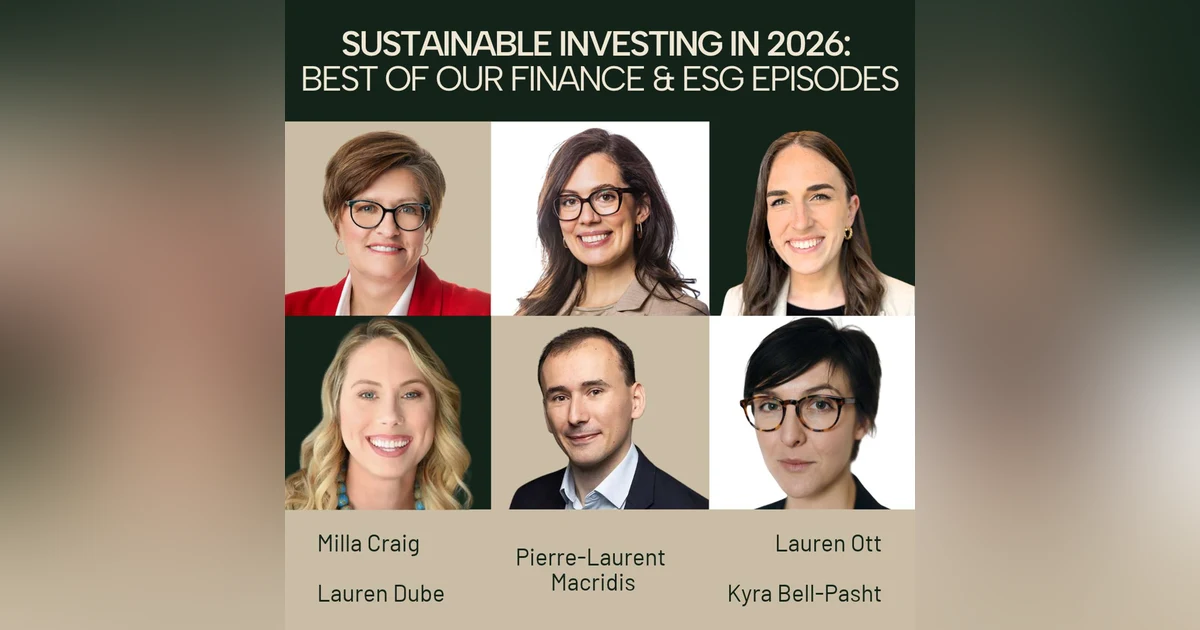
In this special “best of” episode, we revisit our finance conversations in the order we recorded them, tracing how the thinking has evolved:
- Kyra Bell-Pasht (Investors for Paris Compliance) on what net zero really means and how shareholders hold even the biggest banks accountable
- Pierre-Laurent Macridis on the “wedding cake” of responsible, ESG and impact investing, and why a high ESG score can mislead
- Lauren Ott (Impact Genome) on putting real data behind the “S” in ESG, and the rise of cause-washing
- Lauren Dubé (Climate First Bank) on why your bank account is a values choice, and finding common ground in a polarized climate
- Milla Craig (Millani) on why 81% of institutional investors told her ESG isn’t dead, just “no longer enough”
We close with each guest’s answer to our signature question about what it will take to be resilient, plus four takeaways you can act on right now.
Catch the full episodes:
- Kyra Bell-Pasht: https://www.theresiliencereport.ca/4-holding-companies-accountable-for-net-zero-promises/
- Pierre-Laurent Macridis: https://www.theresiliencereport.ca/impact-investing-what-it-is-and-how-it-works-ft-pierre-laurent-macridis-rally-assets/
- Lauren Ott: https://www.theresiliencereport.ca/measuring-social-impact-standardizing-and-quantifying-outcomes-ft-lauren-ott-impact-genome/
- Lauren Dubé: https://www.theresiliencereport.ca/values-based-banking-changing-finance-to-finance-change-ft-lauren-dube-climate-first-bank/
- Milla Craig: https://www.theresiliencereport.ca/esg-consulting-bridging-the-investor-and-company-gap-ft-milla-craig-millani-inc/
Read the Morningstar article that sparked this episode: https://www.morningstar.com/markets/is-sustainable-investing-dead-no-its-taken-root-conventional-investing
All episodes: www.theresiliencereport.ca
Welcome back to The Resilience Report. I'm your host, Lauren Scott.
Today's episode is a little different. When I launched this show in early 2023, ESG was in nearly every headline I read. Conferences were packed, companies were publishing net zero pledges, and new sustainable funds seemed to launch every week.
Three and a half years later, the picture looks very different. In 2025, investors pulled money out of ESG funds for the first time since Morningstar started tracking them. Funds have been renamed. Institutions have stepped away from climate groups. And the question I hear most, from friends, from colleagues and from many of you who write in, is the one you just heard Milla answer: is sustainable finance dead?
I recently shared a Morningstar article that takes on that question, and it sent me back into our own archive. Since our fourth episode, we've welcomed some incredible guests from the world of finance: a climate shareholder activist, an impact investor, a social impact expert, a values-based banker and one of Canada's leading ESG advisors.
When I listened back, I was struck by how much of what they told us still holds. In some cases, they saw what was coming well before the headlines did.
So today, we're going back through those conversations in the order we recorded them. You'll hear the thinking evolve, from questioning whether corporate promises were real, to learning the language of impact, to bringing finance closer to home, and finally to navigating the backlash. At the end, I'll share what I think you, our Resilience Reporters, can keep in mind right now.
Let's start where it began for us, in May 2023.
Our fourth episode ever featured Kyra Bell-Pasht, Director of Research and Policy at Investors for Paris Compliance, a climate shareholder activist organization. Back then, net zero pledges were everywhere, and very few of us could tell a real commitment from a marketing campaign. Kyra started by explaining what net zero actually means.
CLIP: Kyra Bell-Pasht (May 2023)
"When a company commits to Net Zero, it's committing to reduce its greenhouse gas emissions as much as possible, and then offsetting whatever remains [...] it's not just the emissions associated with the 4 walls of your business [...] but also the emissions associated with the products you use for your business and the products your business produces [...] And with a financial sector business like a bank, an insurance company, or an asset manager, your downstream emissions include the businesses that you finance, the businesses that you invest in, the businesses that you underwrite."
Then she gave an example that was driving right past her window.
CLIP: Kyra Bell-Pasht
"I live in Toronto, and the TTC has just started featuring big ads on some of its buses and streetcars. And this ad has a clear blue sky, a bright, hopeful, shining sun, and it says, Net Zero by 2050 [...] I think an average person would look at that ad and say, 'Wow! How fantastic; the oil sands are working on a Net Zero future.' However, I have analyzed this plan, and it doesn't deal with the majority of their emissions: the downstream emissions that come out of the very bus that the ad is covering."
So what do you do about it? For Kyra's team, the answer is to become a shareholder.
CLIP: Kyra Bell-Pasht
"In order to file a shareholder resolution in Canada, you need to have a certain minority stake in the company. So we purchase shares of the companies that we target [...] Recently, for example, we filed at TD Bank, and our resolution received 23.5% of shareholder votes, which doesn't sound like a huge amount, but in the culture of voting to support management [...] it's actually an impressive number, and it's influential on the directors of the company [...] the underlying logic of our shareholder proposals are always based on the premise that transitioning to a Net Zero future is about reducing the company's financial risks and increasing the company's financial opportunities."
Listening back, that last point stands out. Even in 2023, Kyra wasn't making a moral argument to shareholders. She was making a financial one.
That framing is where much of the industry has landed today. According to the Morningstar article, around two-thirds of the US market is now covered by an active stewardship policy. That's a lot of investors having the kinds of conversations Kyra was having with companies three years ago.
But in 2023, many of us were still stuck on the basics.
By early 2024, a number of you had written in asking for help making sense of all the terms being thrown around: responsible investing, ESG, impact investing. So I invited Pierre-Laurent Macridis, then at Rally Assets, who has a real gift for explaining this without jargon. His wedding cake analogy is still the one I use most.
CLIP: Pierre-Laurent Macridis (February 2024)
"You have to think about, let's say, ESG investing as a spectrum, right, or rather I rather call it like tiers of a wedding cake. So, impact investing is the kind of top tier of that cake, so you can't do impact investing without doing ESG, but you definitely can do ESG investing without going all the way up to impact investing [...] The first basic level, the bottom tier of that wedding cake is responsible investing [...] using ESG factors [...] as a risk mitigation tool [...] the next step up [...] instead of just looking at them as a risk mitigation perspective, you're looking at them as an opportunity [...] When you move into impact investing [...] you're trying to think, okay, let's positively contribute to solutions, let's actively do good through these investments."
He also warned that a high ESG score doesn't always mean what we think it does.
CLIP: Pierre-Laurent Macridis
"Some of the top-performing ESG companies are companies like a Philip Morris, right? If you think about changing the world, making the world a better place, selling cigarettes to people isn't what's the first thing that comes to mind, but if you look at a firm like that, they score very highly in terms of ESG because they use, you know, sustainable farming methods, they have short supply chains [...] So you could still be running a really good company, but the core product or service is not actively contributing to positive solutions."
And for anyone building a business, his advice on measuring impact was refreshingly simple.
CLIP: Pierre-Laurent Macridis
"People overcomplicate things, right? [...] Realistically, think about what are the two or three key metrics that are driving that environmental, social impact that you're looking for, and measure those. You don't need all these super fancy methods and processes [...] If you're at least doing that, you're already way ahead of everyone else."
A few weeks later, I spoke with someone who puts measurement at the centre of her work, on the side of ESG I admittedly know less about: the S. Lauren Ott from Impact Genome told me the social side of ESG had mostly been a checklist. She also gave me a term I hadn't heard before.
CLIP: Lauren Ott (April 2024)
"The S right now is really more of a risk mitigation checklist of, did you harm to your employees, maybe perhaps reporting your volunteering hours and your dollars that you've given, but it's not actually getting into what does that mean? You gave $3 million to 3,000 organizations, did that move the needle in any way? [...] We've now seen this, you know, shift from greenwashing in the E space to now [...] cause washing [...] We don't want people to be afraid about doing good, but what we do want is to back them up and support them with the resources that they need in order to show the impact that they're creating."
She shared a great example of what that looks like in practice.
CLIP: Lauren Ott
"A great example is Big Brothers Big Sisters Toronto. They came to us and said this is now their exclusive pitch deck when they're approaching prospective donors [...] They don't need to tell the story of 'we think we're really awesome, please trust us', but instead, they have their third-party verified data to be able to show the impact that they're creating."
What connects Pierre-Laurent and Lauren is a push for evidence over storytelling. Looking back, that has aged really well.
The backlash of the past two years has hit vague claims the hardest. Funds with fuzzy definitions have been renamed or closed. Pledges without plans have been called out. The work that has held up is the work you can actually measure.
From there, we moved from big institutional money to something every one of us touches: our bank account.
In August 2024, I spoke with my almost-namesake, Lauren Dubé, Director of All Good Things at Climate First Bank in Florida. She started with something that genuinely changed how I think about my own money.
CLIP: Lauren Dubé (August 2024)
"Us, as individuals, have idle cash. That idle cash you most likely have sitting in a bank unless it's in your mattress. But for the dollars that are sitting with banks, they're using those for their lending practices. And not that my dollars go to specific loans that I want to see, but rather I'm funding a bank's overall lending practices. So, if I disagree with how that bank is lending their money or it doesn't align with my values, I'm still invested in it. I'm still funding it."
Running a bank with "climate" in its name, in Florida, in an election year, is not easy. I asked her how she handles that.
CLIP: Lauren Dubé
"We've certainly had a hard time with it. Our name speaks for itself and draws a lot of attention [...] it's really been about finding common ground with people who might not agree with our mission or how we view climate change [...] Since we're in Florida, we obviously have a huge tourism industry here that relies on beautiful beaches and clean waterways. We have individuals here who like to hunt and are really passionate about land conservation [...] We're definitely not a bank completely led or owned by Democrats. We have a really lovely mix of individuals [...] At the end of the day, if you take the terms 'climate change' out of it sometimes, we all do really care about the environment that we thrive on."
I come back to that answer often. Pierre-Laurent made a similar point in his episode: much of the pushback against ESG comes from people worried about their jobs and their communities, so a transition only works if it brings people along.
Lauren lives that every day in Florida. It's a reminder that the backlash isn't only a political story. It's also a communication challenge, and one we can all help with.
Which brings us to the guest who answered the question at the heart of this episode.
In December 2024, I sat down with Milla Craig, President and CEO of Millani, who has spent more than 16 years advising both investors and companies on ESG. Milla has watched this space evolve from the very beginning, and she explained the shift that I think is key to understanding where we are today.
CLIP: Milla Craig (December 2024)
"At the time, I intuitively knew that SRI wasn't where the system-level change could take place because it was too restrictive and what we needed to do in my view was move away from that values-driven lens to something that could be much more of a risk management tool [...] So the market moved to something called materiality, which is because when you think about ESG topics, they can be really broad. But what's most important is that we talk about what's material for that organization."
Then I asked her about polarization. Here's the rest of the answer you heard at the top of the show.
CLIP: Milla Craig
"81% of them gave me a very emphatical, 'no, ESG is not dead, but it's no longer enough' [...] I had a portfolio manager who actually told me, even if someone told me 'I can't do ESG' or look at the integration of these topics into my investment approach, the reality is I have a duty to take into my purview the best information and all the information I can to get the best performance for my clients. That's that professional's fiduciary duty."
"These issues will remain. We will get some ups and downs [...] They're large systemic issues that these large investors can't actually invest away from [...] if I'm a pension plan and I invest, you know, I invest around the globe, I can't actually divest away from climate change. I have to invest through that topic."
And for those of us investing as individuals, her advice was direct.
CLIP: Milla Craig
"It's time to ask your advisors, and if your advisor pushes you back a little bit, push again. Because there is a multitude of products in the marketplace, although what you might expect a fund to be may not be what it is, so it's really important to read the fine lines."
When I listened back to this while preparing today's episode, I got a little chill. Milla recorded this almost two years ago, before investors started pulling money out of ESG funds in 2025.
What she described is pretty much what the data shows now. The label has taken a beating, but the practice has become standard. Morningstar reports that 61% of asset owners now say ESG goes hand in hand with their fiduciary duty, up from 53% the year before. That's the portfolio manager Milla was describing.
At the end of every episode, I ask the same question: what will it take for businesses and leaders to be resilient going forward? Here's what each of these guests told me.
CLIP: Kyra Bell-Pasht
"I think that we have to get more than lip service to the climate crisis. Ideally, individuals need to feel deeply within themselves what is happening in nature, how their companies, how their work, how their lives relate to that."
CLIP: Pierre-Laurent Macridis
"I think the answer to that question is a proverb: 'If you want to go fast, go alone; if you want to go far, go together.' [...] If you really want to be resilient, you need to be exposed to other ways of thinking."
CLIP: Lauren Ott
"I think it's going to be an openness to change, an openness to innovation, and a piece of humble pie in understanding that we haven't solved these issues, so perhaps we should pivot and take a new lens."
CLIP: Lauren Dubé
"For businesses and leaders, I think it's really about finding out what's your why and reconnecting with that every chance you feel like you need it [...] It can't just be about profitability anymore."
CLIP: Milla Craig
"Really having a strategy on how you're going to manage these types of issues is key. And then you need to have the courage to move on that strategy as well."
So, is sustainable finance dead? After going back through these conversations, my answer is no. But it has changed, and in some ways I think for the better.
Here's what I think we can all keep in mind right now.
First, look past the label. Funds may be dropping "ESG" from their names, and some companies talk about sustainability far less than they did in 2023. That doesn't necessarily mean they've stopped doing the work. As Milla and Pierre-Laurent both explained, what matters is whether the risks that are material to a business are being managed. So when you look at a fund or a company, look at what it actually does, not what it calls itself.
Second, ask questions, and keep asking. Kyra showed us that shareholders can push even Canada's biggest banks. Milla told us to push our advisors, and then push again. And Lauren Dubé reminded us that even our everyday bank account is a choice. You don't have to be a pension fund to have a voice. Ask your advisor what's in your portfolio. Ask your bank how it lends.
Third, ask for evidence. Whether it's a net zero pledge on the side of a bus or a charity telling you about the lives it has changed, the strongest claims are backed by real data. Lauren Ott and Pierre-Laurent both showed us that measuring impact doesn't have to be complicated. If you run a business, that data is also your best protection against accusations of greenwashing or cause-washing.
And finally, look for common ground. This topic has become so polarized, especially south of the border. But as Lauren Dubé showed us in Florida, starting with values people already share, like clean water, healthy land and strong local businesses, changes the conversation. Most people want the same things. Sometimes we just need to start somewhere different.
There have been moments over the past couple of years when I've wondered whether this movement was losing steam. Going back through these conversations reminded me that the people doing this work never stopped. They adapted, they got more rigorous, and they kept going. I hope you take a bit of that energy with you.
A huge thank you to Kyra Bell-Pasht, Pierre-Laurent Macridis, Lauren Ott, Lauren Dubé and Milla Craig for sharing their expertise with us. Each of their full episodes is linked in the show notes, and I really encourage you to listen to them in full. There's so much more in each conversation than we could fit in today.
Many of our finance episodes started because one of you wrote in asking for them. So if this episode got you thinking, send us a message and let us know which topic you'd like us to dig into next. And if you enjoyed today's show, please leave us a review or share it with someone who's been asking whether sustainable finance is dead.